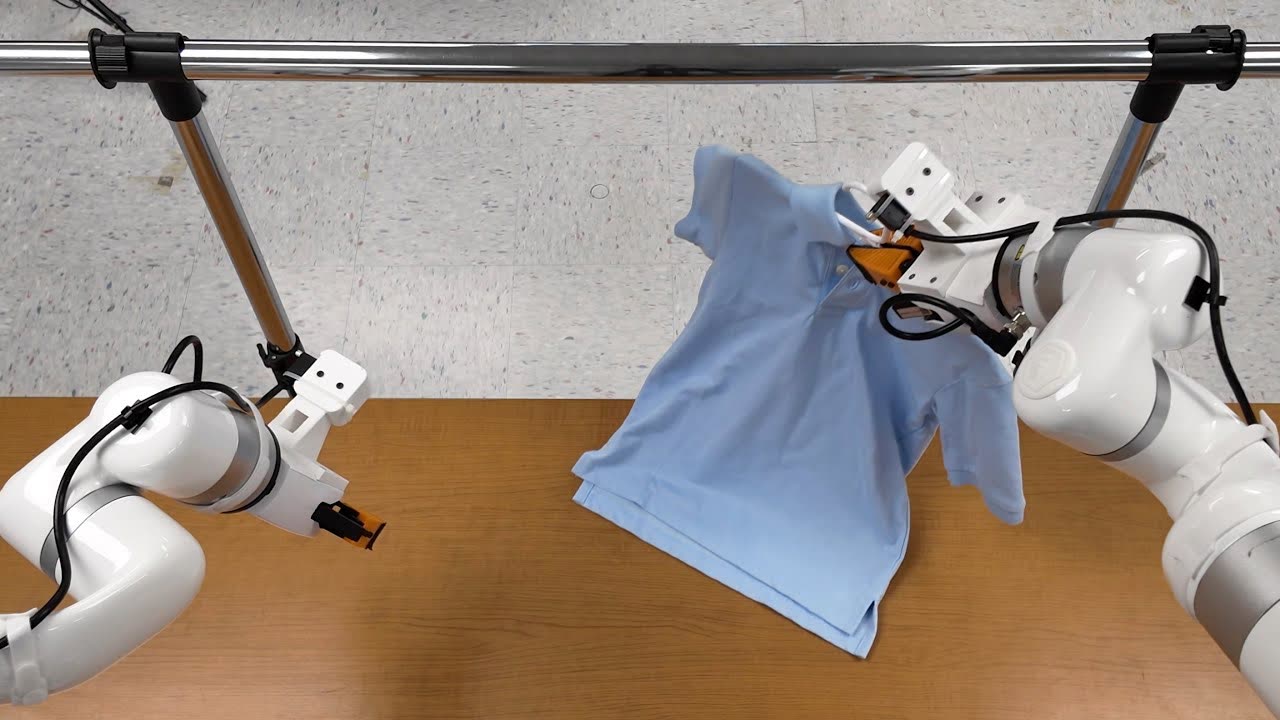
TL;DR RaC achieves efficient performance scaling via a "mid-training" phase added after imitation pre-training. In this phase, RaC scales recovery & correction data via human intervention data collection. Learning on diverse skills data enables policies to reset, retry, and adapt, mitigating compounding errors in long-horizon manipulation tasks.
RaC Data Collection Protocol
RaC standardizes human intervention data collection protocols with two rules:
Upon intervention, operators first recover back to in-distribution states, then perform correction to complete the sub-task.
After intervention completes, operator terminates the episode to prevent further rollouts.
Recovery
Correction
Deployed policy
Expert demos
Adapted from the paper.
Recovery & Correction Improves Robustness to Failures
All videos are autonomous policy rollouts recorded at 1x speed.
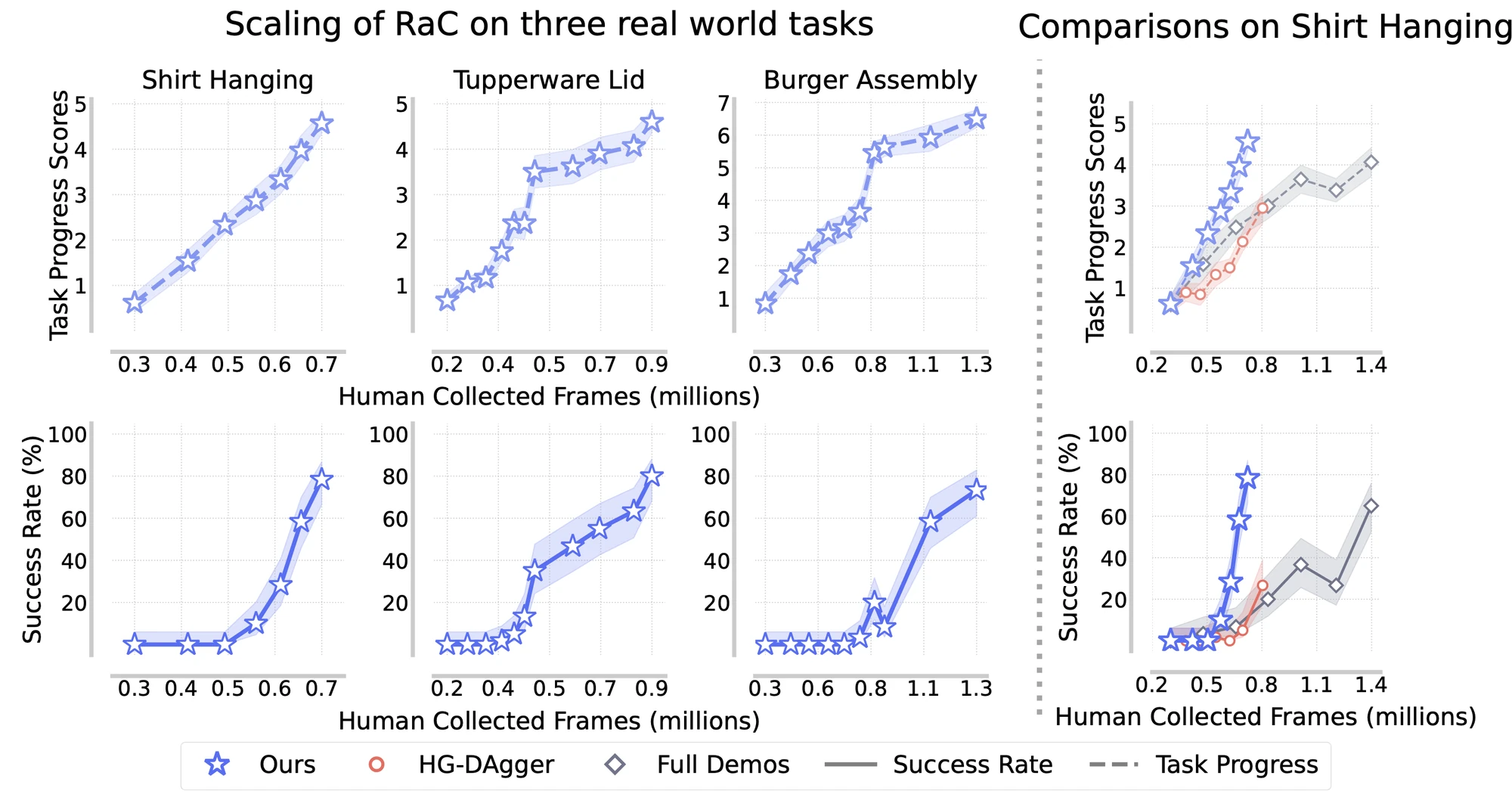
On challenging real world long-horizon manipulation tasks, RaC achieves high success rates with efficient data scaling. It outperforms prior human-in-the-loop method HG-DAgger and conventional batched full expert trajectories data collection.
Compared to previous SOTA results on similar shirt-hanging task, RaC outperforms prior approaches with ~10x less data.
Name
Policy Architecture
Model Size
Training Data Size
SR
ALOHA Unleashed [50]
Diffusion Transformer policy
217M
∼89 hours (5345 shirt-hanging expert demos)
75.0%
Seed GR-3 [7]
Vision-Language-Action model
4B
116 hours of shirt-hanging expert demos and vision-language data
∼63.6%
Ours (RaC)
Flow-matching Transformer policy
368M
5 hours (RaC data: expert, recovery, and correction)
78.3%
Table 1:Comparison to similar shirt-hanging tasks in prior work. Under similar task setups and difficulty, the full task success rate (“SR”) of RaC policy is higher than other methods using an order of magnitude less data. See Appendix D for details.
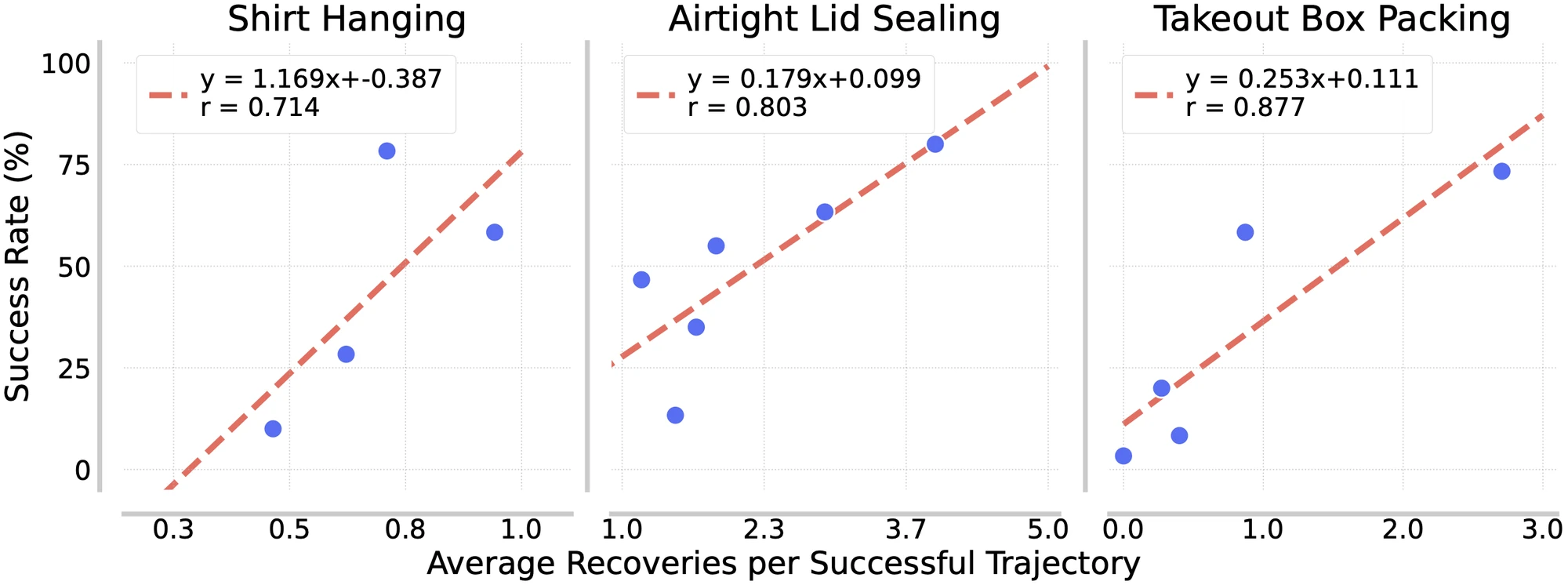
During deployment, RaC exhibits test-time scaling characteristic — full task completion success rises with more recovery behaviors.
BibTeX
@article{hu2026rac,
  title={RaC: Robot Learning for Long-Horizon Tasks by Scaling Recovery and Correction},
  author={Hu, Zheyuan and Wu, Robyn and Enock, Naveen and Li, Jasmine and Kadakia, Riya and Erickson, Zackory and Kumar, Aviral},
  journal={IEEE Transactions on Robotics},
  volume={42},
  pages={2843--2860},
  year={2026},
  doi={10.1109/TRO.2026.3706552}
}